
· Updated 2 September 2026
How to use a japa mala
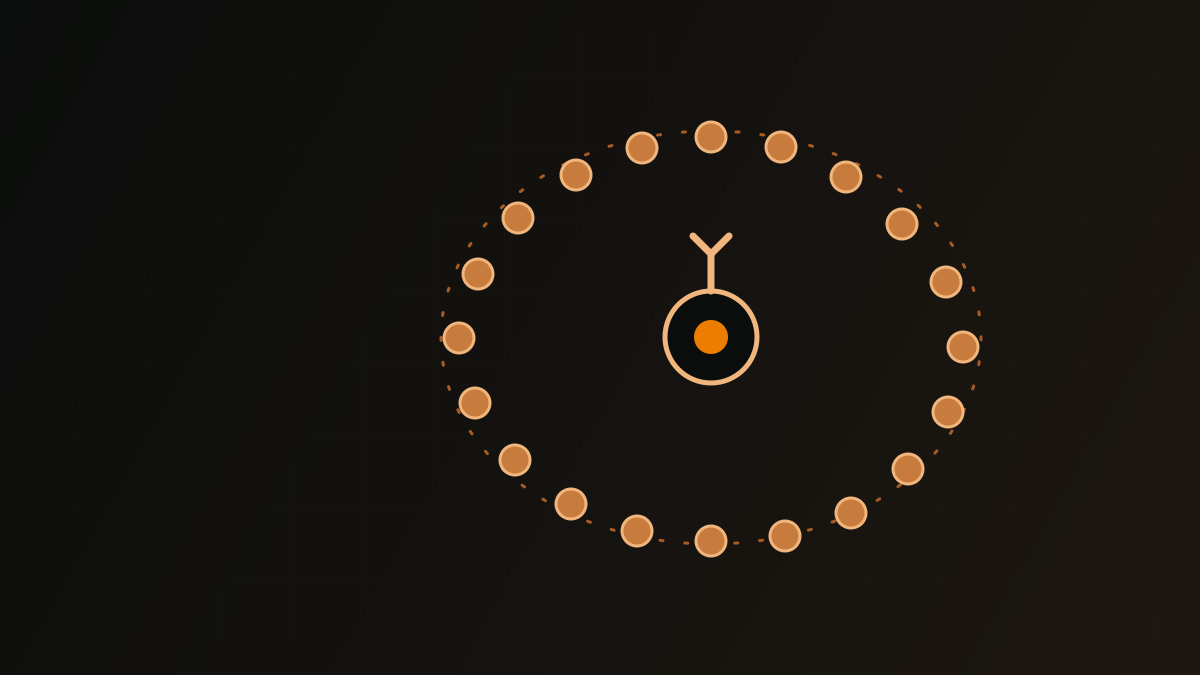
A japa mala is a counting tool with a little gravity. One hundred and eight beads, a distinct bead to mark the turn, and a thread that has been through other hands before yours. It is not a gadget. It is also not so sacred that you should be afraid to pick it up.
If you have been putting off mala practice because you might do it wrong, this is enough to begin. Local custom can refine the rest.
What the mala is for
Japa is repetition: a name, a mantra, a short prayer. The mala keeps count so the mind does not have to. That is the whole mechanical job. The spiritual job is to stay with the recitation while the beads move.
You can count on fingers. You can count in an app. You can count a pile of seeds. The mala is useful because it is tactile, finite, and quiet. One circuit is a complete sitting. You know when you are done without looking at a clock.
For the honesty of that count, read counting japa without turning it into a streak. The mala should not become a scoreboard.
The shape of 108
Most practice malas have 108 counting beads and one extra, often larger, called the guru bead or meru. Some malas include knots or spacers. Some have 27 beads and you do four circuits. If your mala is not 108, do not force the mythology of the number onto a different object. Count what you hold.
Why 108? You will hear astronomical, scriptural, and numerological explanations. They can all be interesting later. For practice, 108 is a length that is long enough to settle and short enough to finish. That is sufficient.
How to hold it
Sit with a straight-enough back. Rest the mala in one hand. A widespread method:
- Use the right hand if that is comfortable and matches your custom.
- Let the strand sit over the middle finger.
- Draw each bead toward you with the thumb.
- Keep the index finger off the beads if that is how you were taught.
Other lineages use both hands, or the left, or a different finger. If a parent or teacher showed you a way, that way is already yours. If nobody showed you, the method above is a decent start. Do not pause the practice for weeks while you hunt for a perfect diagram.
Keep the motion small. You are not performing a craft. You are giving each recitation a bead.
If the mala is long, let the rest of it rest in the other hand or in your lap so it does not swing. If you are walking, keep the hand close to the body.
The guru bead and reversing
When you have travelled all 108 counting beads, you meet the guru bead. Do not cross over it as if it were bead 109.
Pause. That pause can be a bow, a breath, or a moment of silence. If your sitting is complete, stop there. One mala is a whole practice.
If you continue, turn the mala around and go back the way you came. The next bead after the turn is the last counting bead you just used, now leading you in the other direction. You never climb over the guru bead to start a new circle in the same direction.
This feels awkward for two or three sessions and then it does not. The reverse is not a trick. It is a way of treating the marker as a marker.
If you lose your place, do not invent a number. Either restart the mala, or accept an incomplete circuit and stop. A false 108 is a kind of restlessness.
What to recite
Use a mantra you have been given, a name you already say, or a short prayer you can keep without looking at a page. The mala is a poor companion to a long text you are still reading, unless you are counting recitations of that whole text, as some people do with Hanuman Chalisa.
One bead, one recitation. If the mantra is very short, you may still keep one per bead. Speeding up to finish the mala is how the tool starts to own the sitting.
If the mind wanders, the next bead is the return. You do not owe a penalty round.
Care without fuss
Store the mala where it will not be thrown in with keys. A small bag or a hook near the place you sit is enough. Do not soak it in perfume or leave it on a bathroom shelf.
If a bead cracks, restring or replace it when you can. Until then, a broken mala can still count if it stays in sequence. Practice is allowed to look used.
Wearing a mala is a separate choice. If you wear it, decide whether that same strand is also for japa. Some people prefer two: one on the body, one in the bag for sitting. If you only have one, treat public wearing as a reminder, not a display.
When a counter helps
Hands tire. Travel breaks rhythm. A digital counter can sit beside the mala, not instead of it, if you are doing several circuits and do not want to hold the number in memory. Use it to remember how many malas, not to animate a graph.
Mantra Time includes a tactile japa counter with mala targets and undo, for days when the strand is not with you or you want a quiet target of 108 without a public streak. The point is still the name you are saying.
When a circuit finishes, a history row can keep the mantra name, the date, and the japa count. You can delete one session, or share or clear all if you want that. None of it is required to count. The counter is for the sitting.
Begin with one mala a day, at one time, in one place. Learn the guru bead. Reverse when you continue. Let the rest of the lore arrive later, after your fingers already know the way.
FAQ
What is the guru bead and do I count it?
The guru bead is the larger or distinct bead that marks the start and end of the mala. You do not count it as a recitation. When you reach it, pause, then reverse if you continue.
Which hand and which fingers should I use?
A common way is the right hand, mala over the middle finger, beads drawn with the thumb, index finger free. If your tradition teaches otherwise, follow that. Comfort and respect matter more than copying a photograph.
Can I wear a mala and use the same one for japa?
Some people keep a mala only for practice and store it. Others wear one. If you wear it, treat it as a practice object, not jewellery, and keep a simple rule you can keep in public.